
When you’re working with modern electronics, especially high-frequency or precision circuits, small capacitors—those in the few picofarads to a few hundred picofarads range—play an outsized role. They stabilize oscillators, tune RF networks, shape high-speed signals, and define timing behavior in ways large capacitors never could.
Yet when technicians attempt to measure these tiny components using a handheld capacitance meter, the experience is often disappointing:
numbers jump around, readings drift, or the value simply doesn’t match expectations.
If you’ve ever wondered why, the answer is not that your tool is faulty—it’s that small-capacitance measurement is fundamentally delicate, and handheld meters work under unavoidable limitations.
Below, we break down where these errors come from, how to recognize them, and what you can do to reduce their impact.
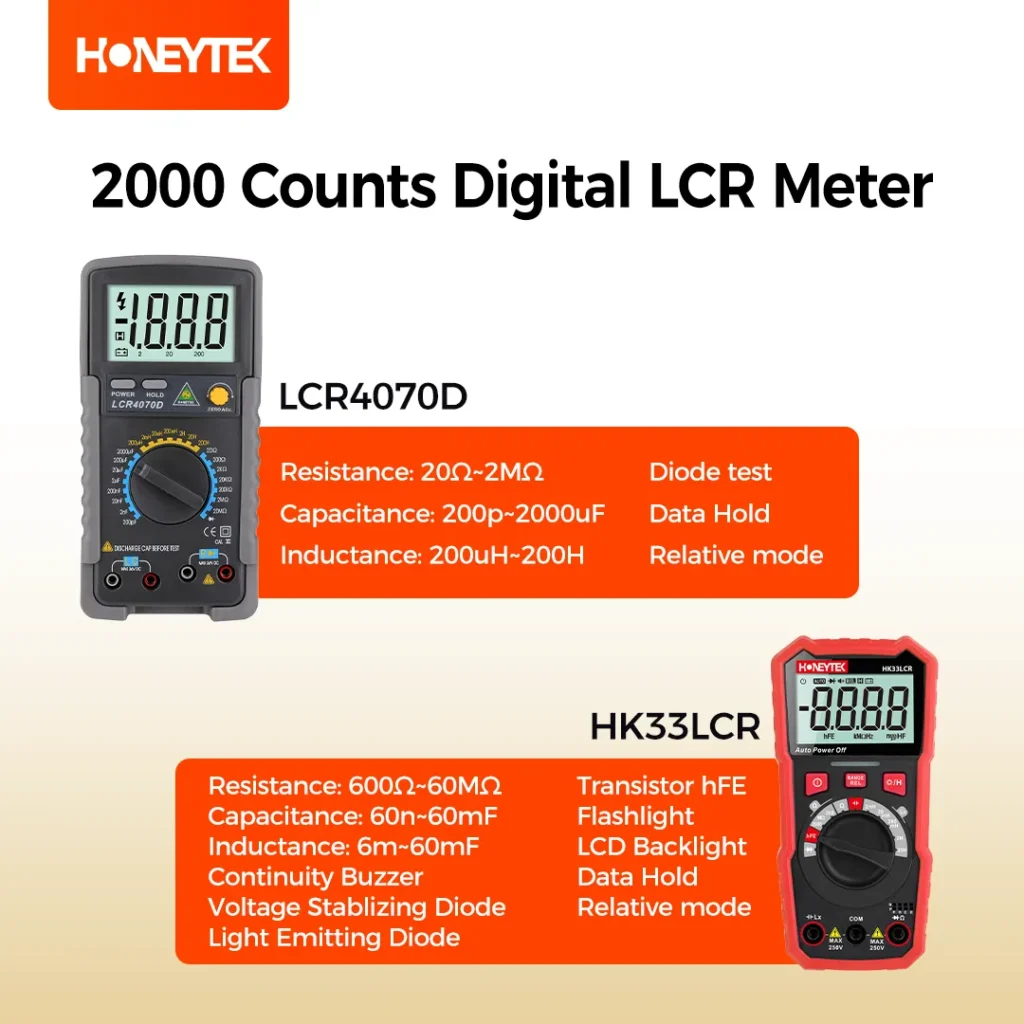
Understanding the Roots of Small-Capacitance Error
Just like safety switches in an industrial electrical system rely on stable detection to perform correctly, capacitance meters rely on clean measurement conditions to generate meaningful results. Small-capacitance readings push every part of that system to the limit.
Let’s explore the most common sources of error.
Instrument-Related Errors
1. Range Limits and Resolution Barriers
A handheld capacitance meter performs best when the measured value sits comfortably within the range it was designed for. When you approach the lower limit of its range:
- The measurement signal becomes very close to the meter’s internal noise floor
- Small fluctuations appear large in relative terms
- Readings “jump” because the meter is resolving picofarads with insufficient resolution
This is why a meter may appear stable when measuring 0.1 µF, yet unstable at 10 pF.
2. Imperfect Test Signals and Internal Circuit Tolerances
Every handheld capacitance meter uses an internal excitation signal—typically a low-frequency AC source or a timed RC charge/discharge path.
For small capacitors, even tiny deviations in:
- excitation voltage
- test frequency
- internal reference components
…can result in surprisingly large percentage errors.
These imperfections are harmless in the nanofarad–microfarad ranges, but at pF levels they become magnified.
3. Zero Drift and Temperature Effects
All measurement electronics drift over time and temperature. In larger ranges these shifts disappear beneath the true capacitance value.
But in the pF region, zero drift becomes indistinguishable from the measurement itself. This often presents as:
- a “phantom” reading of 10–50 pF with the leads open, or
- a slow drift upward as the meter warms up
Handheld meters rarely include the temperature-stabilized circuitry found in lab-grade LCR bridges, so these shifts are unavoidable.
Lead, Fixture, and Connection Errors
4. Parasitic Capacitance From Test Leads
Every cable, clip, tweezers set, or adapter has its own capacitance—often 10–30 pF.
If this isn’t canceled using a REL/ZERO function, the parasitic capacitance simply adds to the reading.
This is why the test leads alone often measure higher than the part you’re trying to evaluate.
5. Contact Variability
When dealing with pF-level components, even slight changes in:
- contact pressure
- oxidation on terminals
- surface area of the clip contact
…can literally alter the effective capacitance of the test setup. What looks like “an unstable reading” may simply be mechanical variation at the connection points.
Environmental and Operator-Induced Errors
6. Stray Electric Fields and Nearby Objects
Small-capacitance testing is extremely sensitive to environmental coupling. Even slight shifts in the electric field around the test setup introduce error.
Common triggers include:
- your hand moving near the test leads
- a metal tool sitting beside the meter
- the test cable swinging slightly in the air
At these levels, the entire surrounding environment becomes part of the measurement circuit.
7. Human Body Capacitance
Your body typically carries 80–200 pF of capacitance to ground.
When you touch or hover near the meter, test leads, or component, the reading can increase dramatically or fluctuate.
This is especially common when measuring with:
- open clips
- unshielded leads
- long wires
Handheld meters simply cannot isolate themselves from this influence.
8. Surface Contamination and Humidity
Dust, moisture, or oils on the capacitor’s surface—even at microscopic levels—can create leakage paths or tiny parallel capacitances.
Ceramic capacitors in particular can show large variations in humid environments unless handled carefully.
Mismatched Measurement Models
9. Testing at the Wrong Frequency
Handheld capacitance meters typically test at very low frequencies (hundreds of Hz to tens of kHz).
But many small capacitors—especially for RF or high-speed use—are designed to operate in the MHz range.
At these high frequencies:
- ESL (equivalent series inductance) becomes significant
- ESR drops dramatically
- phase angle changes
- the “effective capacitance” is different from the low-frequency value
LCR meters address this by letting you choose the appropriate test frequency.
Handheld capacitance meters cannot.
10. High-Q and High-Frequency Capacitor Behavior
C0G/NP0 ceramics, RF capacitors, and precision timing capacitors are engineered for extremely stable performance under specific conditions.
Handheld meters use simplified measurement models that treat capacitors as ideal components—not real devices with ESR, ESL, and frequency-dependent impedance.
As a result, a high-quality capacitor can appear “out of spec” simply because the meter cannot properly characterize its behavior.
Practical Steps to Reduce Small-Capacitance Errors
Just as a disconnect switch safeguards your electrical system with best-practice installation, small-capacitance testing improves dramatically when you follow proven techniques.

Here are the recommended steps:
- Use the REL/ZERO function before every test
- Minimize lead length and use short, shielded fixtures whenever possible
- Avoid touching metal parts of the leads or capacitor
- Keep hands and tools away from the measurement area
- Test in a low-humidity, low-interference environment
- Use an LCR meter when accuracy truly matters or when evaluating RF-grade components
For borderline-small values, you can also use the difference method:
measure a known reference capacitor, add the unknown in parallel, and subtract the two results.
When a Handheld Meter Isn’t Enough
Handheld capacitance meters excel in the nF to µF range and offer fast, convenient troubleshooting for most field applications.
But when your work involves:
- RF circuits
- timing networks
- high-frequency ceramic capacitors
- low-ESL precision components
- laboratory-grade data collection
…only an LCR meter with adjustable frequency and proper calibration can deliver the accuracy required.
If capacitor performance is critical to your design or repair decision, the right tool is not optional—it’s essential.
Need the Right Test Instrument?
Honeytek provides a full range of measurement tools designed to meet technicians, engineers, and manufacturers where they work:
- Portable capacitance meters for fast, dependable onsite tests
- True RMS digital multimeters with extended functions for field diagnostics
- Professional LCR solutions for engineering, R&D, and QA environments
If you’re unsure which tool best fits your measurement needs, our team is here to guide you.
Contact us today and let us help you choose the instrument that delivers the accuracy your application demands.
You May Also Be Interested In:
Why the Honeytek HK39D Is the Ideal Compact Multimeter for Modern Field Technicians
How Students, Vocational Schools, Home Users, and Hobbyists Should Choose a Digital Clamp Meter
How to Choose the Right Clamp Meter for Heavy Industry, Power Stations, Railway Engineering?
