
What BMS Is Extremely Good At —
And What It Was Never Designed For
Battery Management Systems (BMS) are among the most sophisticated subsystems in modern energy storage and electric vehicles.
They calculate SOC and SOH.
They monitor voltage, current, and limits.
They trigger alarms, cut off circuits, and protect the system when thresholds are exceeded.
And yet—thermal incidents still happen.
Sometimes in systems where the BMS never reported a fault.
This is not a failure of engineering effort.
It is a misunderstanding of what BMS is designed to do—and what it is not.
What BMS Is Extremely Good At
Let’s start with clarity.
BMS is exceptionally good at electrical state management.
It excels at:
- Monitoring voltage consistency across cells
- Tracking current flow and charge–discharge behavior
- Estimating SOC, SOH, and balancing needs
- Enforcing predefined safety thresholds
From an engineering standpoint, BMS is a reactive control system.
It responds precisely and reliably once variables cross defined limits.
Within that scope, BMS works extremely well.
The Assumption That Quietly Breaks Battery Safety
The problem begins when we assume:
If the BMS shows no alarm, the battery must be safe.
This assumption is comfortable—but dangerous.
Because many battery failures do not start by violating electrical limits.
They start as localized physical and thermal anomalies.
At the early stage:
- Voltage remains normal
- Current appears balanced
- SOC looks consistent
But heat is already diverging.
What BMS Was Never Designed to See
BMS does not “see” temperature the way engineers often imagine.
Most BMS temperature inputs:
- Are limited to a small number of sensors
- Represent averaged or delayed values
- Are not spatially resolved
As a result, BMS struggles with:
- Isolated hot cells inside a module
- Localized resistance increases at connectors
- Uneven heat removal caused by cooling flow imbalance
These conditions are spatial problems, not purely electrical ones.
And spatial problems require spatial visibility.
The Time Gap That Matters Most
There is a critical time window in battery safety:
The gap between thermal divergence and electrical failure.
In this window:
- The system is already moving toward failure
- But the BMS has no reason to intervene
- Because thresholds have not been crossed yet
By the time voltage deviation or sensor temperature rises enough to trigger alarms,
the system is no longer in a preventive phase.
It is in damage control.
Where Thermal Insight Changes the Equation
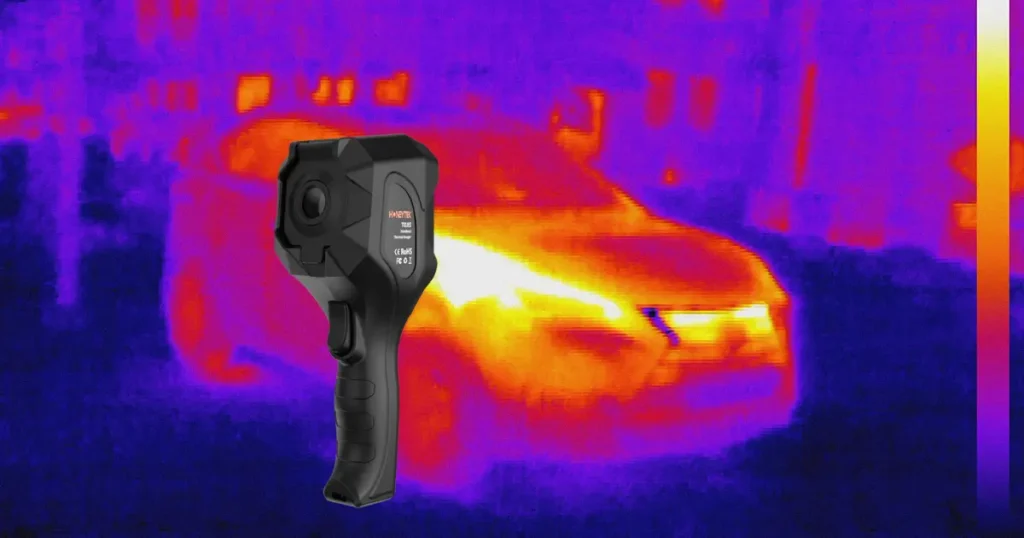
Infrared thermal inspection does not replace BMS.
It complements it at a different layer of judgment.
Thermal data answers a different question:
Where is the system drifting, even if it still looks electrically normal?
By visualizing temperature distribution across:
- Cells
- High-voltage connectors
- Cooling paths
engineers gain early, spatial awareness that no point sensor network can fully provide.
This is why many R&D, validation, and safety teams treat thermal inspection as:
- A front-loaded risk screening tool
- A verification layer for BMS assumptions
- An early-warning system for physical reality
A More Honest Battery Safety Architecture
Battery safety is not a single system.
It is a stack of judgments.
- BMS manages electrical state and protection
- Thermal analysis reveals physical imbalance
- Engineering judgment connects the two
When BMS is treated as the only safety authority, blind spots are inevitable.
When it is treated as one layer among several, safety margins widen.
The Real Question Engineers Should Ask
The most important question is not:
Is the BMS working?
But:
What risks exist before the BMS has a reason to react?
That is where most safety value lives.
About Honeytek
Honeytek develops infrared thermal imagers, digital multimeters, and clamp meters for automotive, energy storage, and industrial testing applications.
- OEM / ODM customization supported
- Engineering-driven product development
- Actively expanding global distributor partnerships
Battery safety does not fail suddenly.
It drifts—quietly, thermally, and early.
