
In new energy vehicles (NEVs), the battery pack (PACK) is not just a power source—it is the lifeline of the entire vehicle.
Modern battery packs consist of hundreds or even thousands of cells connected in complex series-parallel configurations. Within such systems, a single abnormal cell—whether caused by increased internal resistance, localized thermal management failure, or loose electrical connections—can become the trigger point for thermal runaway.
This is why thermal diagnostics have moved from “optional testing” to mandatory risk screening in battery development, validation, and after-sales inspection.
Infrared thermal imaging plays a decisive role in this process.
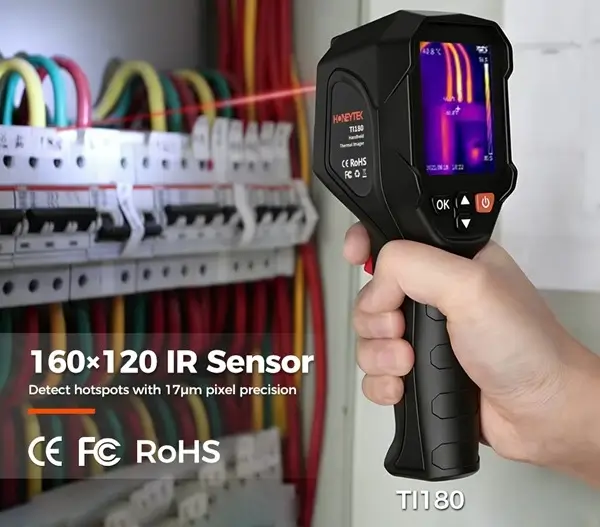
1. Cell Heating Consistency Analysis During Charge–Discharge Cycles
One of the most critical indicators of battery health is cell temperature uniformity.
Using the TI185 high-resolution handheld infrared thermal imager from Honeytek, engineers can monitor the real-time thermal distribution of battery modules during charging and discharging cycles.
Engineering Diagnosis Logic
Under normal operating conditions, the temperature difference between cells should remain within a very narrow range, typically:
ΔT < 5 °C
Thanks to the high pixel density and thermal sensitivity of the TI185, engineers can quickly identify isolated “hot-spot” cells that deviate from the thermal baseline.
Such abnormal heating patterns often indicate:
- Increased internal resistance
- Capacity degradation
- Early-stage electrochemical instability
Identifying these cells early allows engineers to eliminate fire and self-ignition risks before they escalate, long before voltage or capacity anomalies become visible.
2. High-Voltage Connectors and Harness Node Inspection
Inside and around the battery pack, high-voltage power distribution units (PDU) contain numerous bolted joints and plug-in connectors.
These connection points are particularly vulnerable to:
- Vibration-induced loosening
- Oxidation and corrosion
- Contact resistance increase under high current
Risk Identification with Thermal Imaging
The TI175 industrial-grade infrared thermal imager is designed to detect subtle temperature rises caused by increased contact resistance.
In thermal images, these faults appear as distinct localized hot spots, clearly differentiating them from normal conductive heating.
This enables maintenance teams to:
- Tighten or replace faulty connectors in advance
- Prevent circuit burnout and insulation damage
- Ensure safe and efficient high-current transmission
Thermal inspection here acts as a fire-prevention mechanism, not a post-failure diagnostic.
3. Thermal Management System Performance Evaluation
(Liquid Cooling / Air Cooling)
Thermal management efficiency directly determines battery lifespan and safety margins.
Infrared thermal imaging provides a non-contact method to visually evaluate:
- Coolant flow paths
- Heat dissipation uniformity
- Surface temperature gradients across cooling plates
Engineering Validation Value
By analyzing temperature distribution on the battery surface or cooling plates, engineers can detect:
- Coolant blockage
- Uneven flow rates
- Condensation or localized cooling failure
This method provides scientific, visual evidence for both structural design optimization and after-sales cooling system maintenance—without dismantling the battery pack.
Honeytek Engineering Insight
By using the TI185’s full-radiometric video recording function, engineers can capture the entire thermal evolution of a battery pack throughout charge–discharge cycles.
This generates a complete thermal trend curve, offering valuable data support for:
- Laboratory R&D analysis
- Battery aging studies
- Failure mode validation
Thermal imaging thus becomes a time-based diagnostic tool, not just a static inspection method.
From Detection to Prevention: Why Thermal Imaging Matters
Infrared thermal imaging shifts battery safety strategy from reactive repair to predictive risk control.
Its value lies in answering one key engineering question:
Where will failure start—before it actually happens?
When integrated correctly, thermal inspection helps NEV manufacturers and service teams:
- Reduce thermal runaway risk
- Improve battery consistency and reliability
- Shorten diagnostic cycles
- Lower total safety-related costs
Frequently Asked Questions (FAQ)
Q1: Can thermal imaging detect battery risks before BMS alarms are triggered?
Yes. Temperature anomalies often appear earlier than voltage or current deviations detected by the BMS.
Q2: Is infrared inspection safe for high-voltage battery systems?
Yes. Thermal imaging is non-contact, making it inherently safer when inspecting energized systems.
Q3: Can Honeytek instruments be customized for battery OEM applications?
Yes. Honeytek supports OEM / ODM customization, including hardware configuration, firmware, and branding.
Q4: Is thermal imaging suitable for both R&D and after-sales service?
Absolutely. High-resolution models are ideal for R&D and validation, while industrial models support long-term field and workshop use.
Honeytek is a professional manufacturer of infrared thermal imagers, digital multimeters, and clamp meters, serving the automotive, energy, and industrial testing sectors worldwide.
- OEM / ODM customization supported
- Engineering-driven product development
- Actively recruiting global distributors and agents
📩 Contact Honeytek to explore partnership opportunities and advanced diagnostic solutions for new energy vehicles.
You May Also Be Interested In:
- How to Use a Clamp Meter Correctly: Why Clamping Two Wires Shows Zero Current
- Common Clamp Meter Mistakes: Misunderstanding Range and Accuracy
- How to Choose the Right Digital Multimeter
- Why Insulation Testers Are Essential for EV and Hybrid Diagnostics
- How to Measure Insulation Resistance with a Multimeter
- How to Measure Insulation Resistance in Solar PV Systems: The Professional Guide
