
Choosing between a consumer-grade and an industrial-grade infrared thermometer is less about price—and more about using the right tool for the right job.
Home kitchens, HVAC checks, and basic inspections prioritize ease of use and moderate temperature ranges. Industrial environments, on the other hand, demand wider temperature coverage, better optical performance, adjustable emissivity, and rugged construction.
This guide breaks down the real differences, helping you select an infrared thermometer based on application first, then specifications.
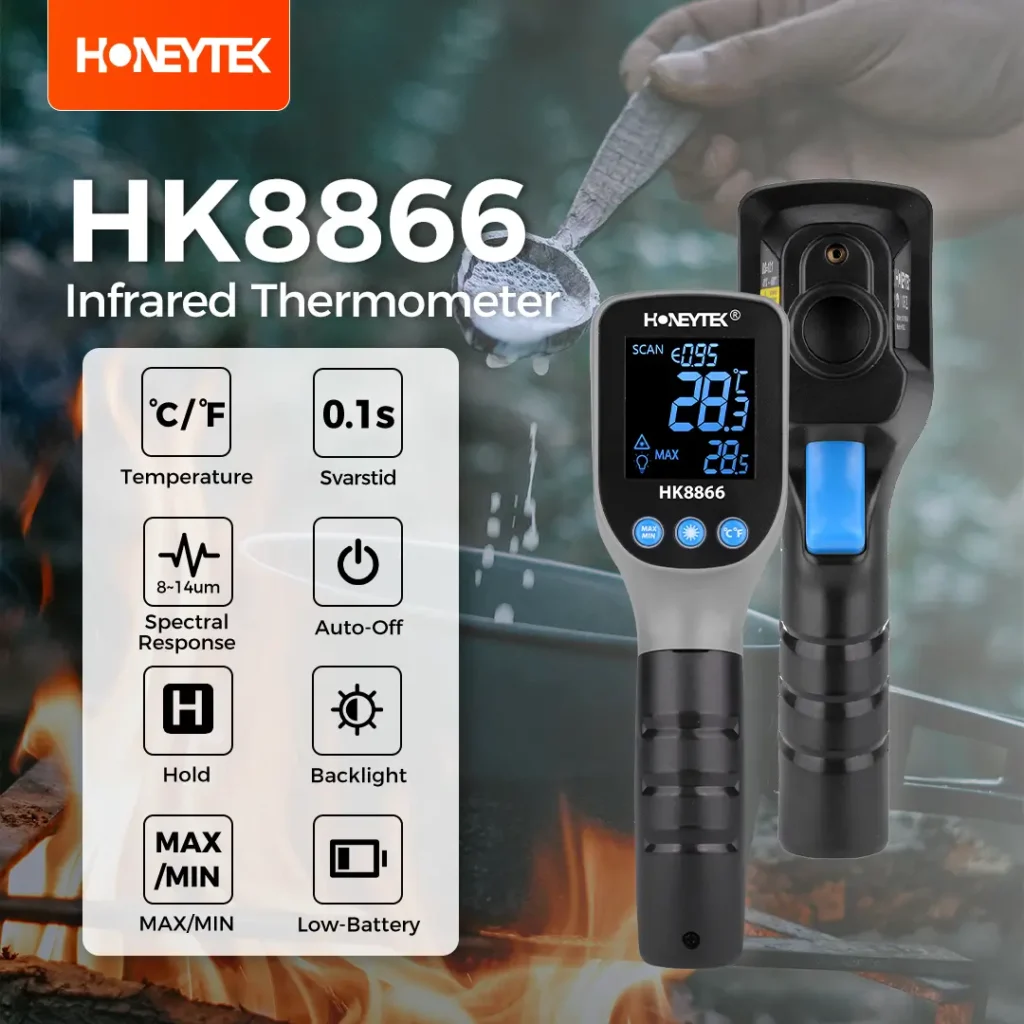
Start with the Application and Temperature Range
Consumer-Grade Typical Uses
- Cooking, ovens, frying pans, pizza ovens
- Coffee roasting and brewing
- BBQ and grilling
- Home HVAC checks
- Basic automotive diagnostics
Typical temperature range:
Approximately –50 °C to 380 / 500 °C
These scenarios rarely require extreme accuracy or long-distance measurement.
Industrial-Grade Typical Uses
- Electrical cabinets and substations
- Kilns and furnaces
- Metallurgy and foundries
- Plastics and injection molding
- Cold storage and refrigeration
- Industrial HVAC maintenance
Typical temperature range:
From sub-zero cold rooms up to 800 °C, 1000 °C, or higher

Key Technical Differences at a Glance
| Parameter | Consumer Infrared Thermometers | Industrial Infrared Thermometers |
|---|---|---|
| Temperature Range | –50 to 380 / 500 °C | –50 to 800 / 1200 °C or more |
| Accuracy | ±1–2 °C acceptable | Tighter tolerances & repeatability |
| D:S Ratio | 5:1, 8:1, 12:1 | 16:1, 30:1, or higher |
| Emissivity | Fixed (often 0.95) | Adjustable or material presets |
| Housing | Lightweight plastic | Rugged, drop-resistant, IP-rated |
| Functions | Basic display, laser, hold | Data logging, alarms, outputs, comms |
How to Choose a Consumer Infrared Thermometer
Consumer models are designed for simplicity and speed, not extreme environments.
What to Look For
- D:S ratio of 8:1 or 12:1
Ideal for close-range cooking and household tasks - Fast response time (≤ 500 ms)
Helps when checking hot surfaces quickly - Clear backlit display
Useful in kitchens, garages, or low-light conditions
Helpful Bonus Features
- High-temperature alarm
- Max/Min value display
- Data hold function
These features add practical value at low cost.

How to Choose an Industrial Infrared Thermometer
Industrial users should prioritize measurement reliability over convenience.
Core Selection Criteria
- Temperature range that covers process extremes
- Adequate accuracy and resolution in the critical operating zone
- High D:S ratio (≥16:1 or 30:1) to measure small targets from a distance
Optical and Mechanical Considerations
- Adjustable emissivity for metals, plastics, ceramics
- Compatibility with different optics or protective windows
- Rugged housing, sealed buttons, and IP-rated protection
These factors are essential in dusty, oily, humid, or high-temperature sites.
Universal Tips and Common Pitfalls
Know What Infrared Thermometers Cannot Measure Well
- Mirror-like or highly reflective metals
- Transparent materials (glass, clear plastics)
In such cases, emissivity adjustment or using black tape/paint reference spots is necessary.
Don’t Ignore Calibration and Support
For industrial safety, quality control, or food compliance:
- Choose brands with clear specifications
- Ensure calibration guidance is available
- Confirm warranty and long-term support
Manufacturers like Honeytek provide infrared thermometers alongside digital multimeters and clamp meters, supporting OEM customization for both consumer and industrial markets—without overcomplicating product selection.
Featured Snippet FAQ (SEO-Optimized)
What is the main difference between consumer and industrial infrared thermometers?
Consumer models focus on ease of use and moderate temperatures, while industrial models support wider ranges, higher D:S ratios, adjustable emissivity, and rugged designs.
Is a higher D:S ratio always better?
Not necessarily. High D:S is essential for long-distance or small-target measurements but unnecessary for close-range kitchen or home use.
Can consumer infrared thermometers be used in industrial settings?
They can be used for basic checks, but they may lack durability, accuracy, and emissivity control required for industrial safety and quality control.
Do industrial infrared thermometers need calibration?
Yes. Regular calibration ensures accuracy, especially when used for safety inspections or production monitoring.
Why can’t infrared thermometers read shiny metal accurately?
Shiny surfaces reflect ambient infrared radiation, leading to incorrect readings unless emissivity is adjusted or reference methods are used.
Conclusion
There is no “best” infrared thermometer—only the right tool for the job.
Consumer-grade models excel in kitchens, homes, and light diagnostics. Industrial-grade instruments are built for precision, durability, and reliability in demanding environments.
Start with your application, define your temperature range, then evaluate optical performance and build quality. This approach prevents overpaying—or under-specifying.
If you are sourcing infrared thermometers, digital multimeters, or clamp meters for retail, industrial projects, or branded OEM programs, working with an experienced manufacturer matters.
Explore how Honeytek supports global customers with scalable manufacturing, OEM customization, and measurement instruments designed for real-world use—across both consumer and industrial applications.
You May Also Be Interested In:
- AC-Only vs. AC/DC Clamp Meters: Choosing the Right Tool for Your Electrical Applications
- Why Handheld Capacitance Meters Struggle With Small-Capacitor Measurements
- How to Measure DC Current in a Photovoltaic (PV) System Using Clamp Meter
- Accuracy Comparison of Digital Multimeters, Portable Capacitance Meters, and LCR Meters
- Portable Capacitance Meter vs. LCR Meter: What’s the Real Difference?
- How to Measure DC Current with Clamp Meter
