
How to Use a Clamp Meter Correctly
Why Clamping Two Wires Shows Zero Current — and When You Should Do It on Purpose
1. The Common Confusion in the Field
This situation happens to almost every beginner—and many experienced users at least once.
You try to measure the current of a household appliance, such as:
- a rice cooker
- an air conditioner
- a power tool
You clamp the meter around the entire power cord.
The appliance is clearly running, but the clamp meter displays:
- 0 A, or
- a value very close to zero
Naturally, the questions arise:
- “Is my clamp meter broken?”
- “Why can’t I measure any current?”
This article explains why this happens, what the physics behind it really are, and how the same phenomenon is deliberately used for leakage current detection.
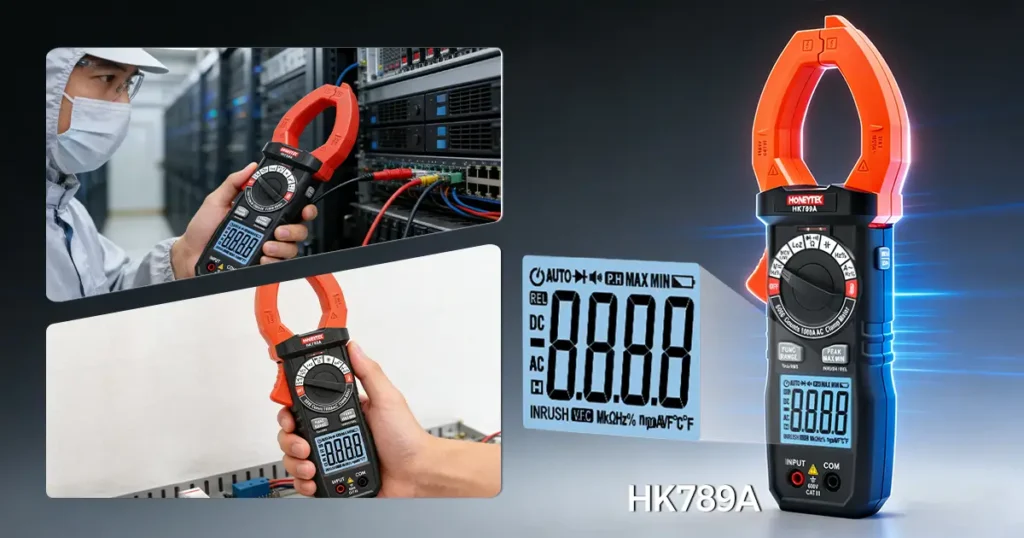
2. The Core Principle: Magnetic Field Cancellation
How a Clamp Meter Measures Current
A clamp meter does not measure current directly.
Instead, it:
- senses the magnetic field generated around a conductor
- converts that magnetic flux into a current reading
No magnetic field → no measurable current.
The Nature of Single-Phase Power
In a standard single-phase AC system:
- Live (L) wire: current flows out to the load
- Neutral (N) wire: current flows back from the load
Key fact:
The current magnitude is the same, but the direction is opposite.
Why Clamping Two Wires Gives Zero
When you clamp both L and N wires together:
- Each wire generates a magnetic field
- The two magnetic fields point in opposite directions
- They cancel each other out
Mathematically:
- +I + (−I) = 0
As a result:
- Net magnetic flux inside the clamp = zero
- Clamp meter reading = 0 A
👉 Conclusion:
The clamp meter is not faulty.
This is exactly what physics predicts.
3. The Correct Way to Measure Load Current
The Golden Rule
Always clamp only ONE conductor.
You may clamp:
- the live wire or
- the neutral wire
Both give the same current magnitude.
Practical Challenge with Household Appliances
Most appliance power cords:
- contain two or three conductors
- are wrapped together inside insulation
- cannot be separated easily
Practical Solutions
Option 1: Measure at the wiring point
- Distribution board
- Socket terminal
- Appliance connection block
Option 2: Use a Line Splitter
A line splitter physically separates live and neutral conductors internally, allowing:
- safe
- quick
- non-invasive current measurement
No cable cutting required.
4. The Reverse Logic: When You SHOULD Clamp Multiple Wires
Here comes the important twist.
If clamping two wires gives zero, then what does it mean when it doesn’t?
Leakage Current Explained
In a healthy circuit:
- Current flowing out = current flowing back
- I_in − I_out = 0
If insulation degrades or a fault occurs:
- Part of the current leaks to ground or through unintended paths
- Return current becomes smaller
Now:
- I_in − I_out ≠ 0
That small difference is called leakage current.
How Clamp Meters Detect Leakage
- Single-phase system:
Clamp L + N together → reading = leakage current - Three-phase, three-wire system:
Clamp R + S + T together → reading = total leakage or imbalance current
The displayed value is usually very small (mA level).
Important Limitation
Standard clamp meters are designed for load current, not leakage detection.
For accurate leakage measurement:
- A high-sensitivity leakage clamp meter is required
- Typical resolution: 0.1 mA or better
5. Rules to Remember
Core Logic Recap
- Measuring load current → clamp ONE wire
- Measuring leakage current → clamp ALL current-carrying wires
- (L+N for single-phase, R+S+T for three-phase)
- Do not include the ground wire
Safety Reminder
When measuring live circuits:
- Always follow proper electrical safety procedures
- Use clamp meters with appropriate CAT ratings
- Never expose bare conductors without proper protection
Clamp meters and multimeters are the electrician’s eyes.
Understanding why a reading is zero is more valuable than memorizing how to use the tool.
Once you understand the principle, you gain both confidence and diagnostic insight—from basic load measurement to advanced leakage detection.
Frequently Asked Questions (FAQ)
Q1: Is it dangerous to clamp both live and neutral wires?
No, it is electrically safe—but it will not show load current.
Q2: Can I measure leakage current with a normal clamp meter?
Only roughly. Accurate leakage measurement requires a dedicated leakage clamp meter.
Q3: Why does the reading fluctuate slightly when clamping two wires?
Minor imbalance, external magnetic fields, or noise can cause small residual readings.
Q4: Should the ground wire be included in leakage measurement?
No. Only current-carrying conductors should be clamped.
Honeytek is a professional manufacturer of digital multimeters, clamp meters, and electrical test instruments for industrial and professional applications.
You May Also Be Interested In:
- Why Insulation Testers Are Essential for EV and Hybrid Diagnostics
- How to Measure Insulation Resistance with a Multimeter (Megger Test)
- How to Measure Insulation Resistance in Solar PV Systems: The Professional Guide
- Solar PV Inspection Checklist: How to Troubleshoot 1500V Systems Safely
- How to Detect Industrial VFD Faults Without Interrupting Power Supply?
