
A clamp meter looks simple: open the jaws, clamp a conductor, read the current. In the field, though, the “right” clamp meter is the one that matches your real workloads—distribution panels, motor circuits, VFD-driven equipment, PV/ESS, tight control cabinets, long shifts, and high safety expectations.
This guide walks through the parameters that actually determine whether a clamp meter will be accurate, safe, and efficient in an electrician’s day-to-day work.
Start With the First Question: What Will You Measure?
Before comparing models, define the circuits you touch most often:
- Traditional building loads (lighting, heaters, standard motors)
- Industrial distribution (large motors, compressors, busbars)
- Modern power electronics (VFDs, UPS, EV chargers)
- Solar PV, energy storage systems, DC buses
- Maintenance diagnostics (inrush, harmonics symptoms, intermittent faults)
That single list determines whether you need AC-only or AC+DC, True RMS, higher CAT ratings, or specialty functions like inrush and low-pass filtering.
AC Only vs AC+DC: Don’t Guess—Match the Site Reality
When an AC clamp meter is usually enough
If you mainly handle conventional building distribution and pure AC loads (and you rarely see VFD outputs, rectifiers, or DC systems), an AC clamp meter can cover the basics.
That said, True RMS AC is still the better choice because many real-world waveforms are not clean sine waves—especially with LED drivers and switching power supplies.
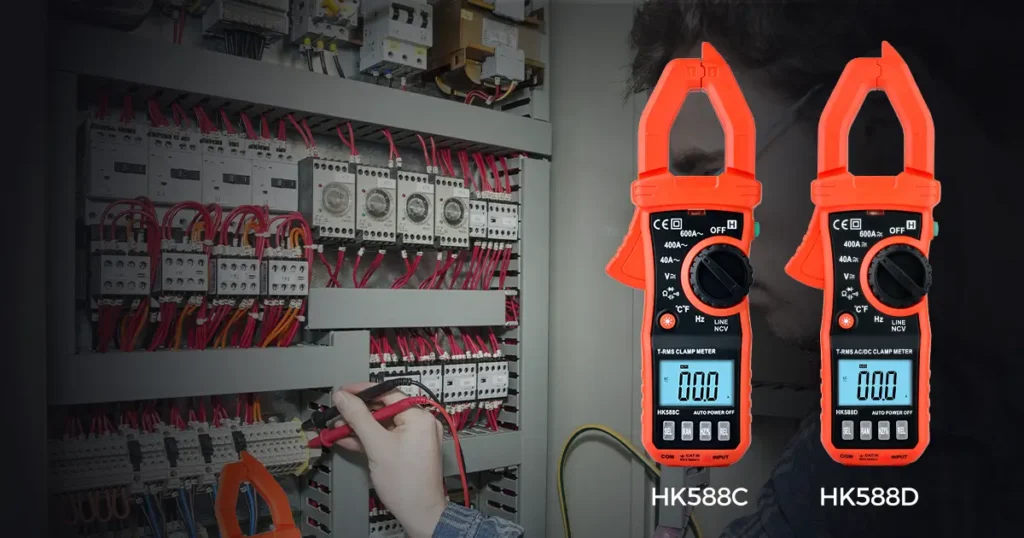
When you must use AC+DC + True RMS Clamp Meter
If you work around any of the following, AC+DC with True RMS is a practical requirement:
- VFD/motor drives
- Solar PV and storage (ESS)
- UPS systems and rectifiers
- EV/charging infrastructure
- DC buses, battery systems, control power with DC loads
Why it matters: non-sinusoidal current and mixed waveforms can cause non-True-RMS meters to read significantly wrong. And an AC-only clamp meter simply won’t measure DC current.
Field rule: If your customer sites include PV/ESS, VFDs, UPS, or EV, default to AC+DC True RMS.
Current Range and Resolution: “Measure Big” and “See Small”
Maximum current range
Choose the range based on the largest circuits you expect—then leave margin.
- Residential/light commercial: 400–600 A is common
- General electrical field work and mixed sites: 600–1000 A is safer
- Industrial distribution, large motors, busbar work: 1000 A+ preferred
If you regularly deal with very high currents (or thick conductors that don’t fit), consider a meter that supports a flexible current coil to extend measurement (often into the 2000–3000 A class).
Resolution (how fine the readings are)
Range tells you whether you can measure the current at all; resolution tells you whether the number is useful.
- Checking overloads / quick go-no-go: 0.1 A resolution is typically fine
- Load balancing, diagnosing abnormal standby draw, trending small changes: 0.01 A (or finer) becomes valuable
Field rule: If you do troubleshooting (not just checks), prioritize better resolution.
Jaw Size and Jaw Geometry: The Difference Between “Fits” and “Frustrating”
Jaw opening (diameter) should match your conductors
Think about what you clamp most often:
- Typical branch circuits in panels: 25–30 mm is usually workable
- Main feeders, HVAC, elevators, motor supply cables: 30–40+ mm is more comfortable
- Thick cables, busbars, parallel conductors: consider 40 mm+ or a flex coil option
Slim jaws help in tight cabinets
If you frequently work in dense control panels—tight breaker gaps, crowded distribution boards, narrow wire ducts—look for:
- Slim jaw arms
- Easier one-handed operation
- A shape that can reach the conductor without forcing awkward angles
Field rule: A slightly larger jaw and a slimmer profile often outperform “bigger numbers” on paper.
Safety Ratings: CAT Category Is Not a Marketing Detail
Electrical measurement is about more than “can it read voltage.” Your meter must survive transients safely.
Recommended minimums for electricians
- CAT III 600 V: baseline for most panel and building distribution work
- CAT III 1000 V or CAT IV 600 V: strongly recommended for service entrances, industrial environments, and higher-energy circuits
Also confirm the meter’s maximum voltage rating (commonly 600 V or 1000 V). Do not use an underrated meter in higher-energy locations.
Field rule: When in doubt, choose the higher CAT rating—especially for distribution and industrial service work.
Accuracy: What “Good Enough” Looks Like in the Field
Not every job requires lab-grade numbers, but accuracy affects decisions—especially when diagnosing overheating, nuisance trips, motor loading, or phase imbalance.
- Professional field work: aim for ±(1% to 2% of reading + digits) class specs
- Basic maintenance / household service: ±2% to 3% may be acceptable
Accuracy alone isn’t everything—True RMS, stability, and filtering often matter more in modern waveforms.
Features That Actually Save Time on Site
Below is a practical priority list—features that frequently pay for themselves in faster troubleshooting and fewer return visits.
Must-have functions for most electricians
- AC/DC voltage (depending on your environment)
- Continuity + resistance
- Data hold
- Backlight (and a readable display)
High-value functions for diagnostics
- Inrush current (INRUSH): critical for motor starts, compressors, and identifying startup stress
- Low-pass filter (LPF / VFD mode): helps stabilize readings on VFD-driven outputs
- MIN/MAX: captures spikes and intermittent loads
- Frequency (Hz): useful for motor supply verification and drive behavior checks
Convenience and safety boosters
- NCV (non-contact voltage detection): quick “is it live?” checks (not a replacement for proper verification)
- Work light / flashlight
- Glove-friendly buttons and selector switch
- Auto power-off, clear low-battery indication
Field rule: If you do motor/industrial work, prioritize INRUSH + LPF.
Durability and Ergonomics: The Hidden Spec That Impacts Productivity
A clamp meter can have excellent specs and still be the wrong tool if it’s uncomfortable or fragile.
Look for:
- Drop resistance and protective overmold
- Solid rotary switch feel (no vague “half-clicks”)
- Strong jaw hinge and consistent closing
- Display visibility from multiple angles
- A form factor you can hold steady with one hand
If you work long shifts, these details matter as much as the datasheet.
Data Logging and Bluetooth: Useful When You Maintain, Not Just Measure
Wireless logging and app-based trending are not mandatory for every electrician, but they can be highly valuable for:
- Preventive maintenance programs
- Long-duration current monitoring
- Evidence capture for reports and warranty claims
- Diagnosing intermittent faults that don’t appear during a quick check
If your work includes inspections, maintenance contracts, or facility operations support, “smart” features can reduce repeat site visits.
A Simple Selection Checklist You Can Use Today
Use this process to pick the right clamp meter class quickly:
Define waveform and system type
- Any DC, PV/ESS, UPS, VFD, EV? → AC+DC True RMS
Choose current range
- Everyday distribution work → 600 A
- Industrial / large motors → 1000 A+ and consider flex coil support
Match jaw size to conductors
- Branch circuits → 25–30 mm
- Feeders and motor supply → 30–40+ mm
- Busbars / very thick cables → larger jaws or flex coil
Set safety category
- Minimum: CAT III 600 V
- Prefer: CAT III 1000 V or CAT IV 600 V for higher-energy environments
Add functions based on tasks
- Motors: INRUSH
- VFD sites: LPF/VFD mode
- Troubleshooting: MIN/MAX + good resolution (0.01 A)
Common Mistakes to Avoid
- Buying AC-only for sites that include DC or PV/ESS
- Ignoring True RMS when measuring distorted waveforms
- Choosing a jaw that can’t fit your most common cable sizes
- Under-spec’ing CAT ratings for distribution and service work
- Paying for features you won’t use while skipping the ones you need (like INRUSH on motor work)
FAQ
Do I really need True RMS?
If your environment includes switching power supplies, VFDs, UPS systems, or modern electronic loads, True RMS is strongly recommended. It improves accuracy when the waveform is not a clean sine wave.
Is NCV enough to confirm a circuit is safe?
No. NCV is a useful screening tool, but it does not replace proper test procedures with rated instruments, verified leads, and safe work practices.
What jaw size should I choose for general electrical work?
For mixed field work, 30–40 mm is often a practical “sweet spot.” If you frequently work on thick feeders or crowded panels, jaw geometry and slimness can matter as much as the maximum opening.
When should I consider a flexible current coil?
When currents exceed the meter’s jaw capacity, conductors are too large to clamp, or you’re measuring around busbars and bundled cables where a rigid jaw won’t fit.
What CAT rating is appropriate for electricians?
CAT III 600 V is a common minimum for panel work. For service entrances and industrial distribution, CAT III 1000 V or CAT IV 600 V is typically the safer choice.
Select a Clamp Meter Built for Real Field Work
If you are sourcing clamp meters for electrical contractors, facility maintenance teams, distributors, or OEM tool programs, choose equipment that aligns with modern jobsite realities: AC+DC systems, distorted waveforms, higher safety categories, and durable daily handling.
Honeytek manufactures digital clamp meters and digital multimeters for professional field use, and we support OEM/ODM customization (branding, labels, packaging, feature configuration) for distributors and industrial buyers.
You may like these:
- How to Choose the Right Jaw Opening for Your Digital Clamp Meter
- Key Specifications for Choosing an Industrial High-Current Clamp Meter
- How to Measure DC Current in a Photovoltaic (PV) System Using Clamp Meter
- AC-Only vs. AC/DC Clamp Meters: Choosing the Right Tool for Your Electrical Applications
- Accuracy Comparison of Digital Multimeters, Portable Capacitance Meters, and LCR Meters
