
Selecting the optimal clamp meter isn’t just about current range or True RMS capability—it starts with one often-overlooked but critical spec: jaw opening size. And in modern electrical environments, the smartest professionals don’t just pick one tool—they combine rigid-jaw clamp meters with **flexible current probes **(Rogowski coils) to cover both everyday precision tasks and extreme-field challenges.
The right combination hinges on three factors:
✅ Conductor size and layout
✅ Current magnitude
✅ Accuracy and safety requirements
Let’s break down when to use what—and how to build a versatile, future-ready measurement toolkit.
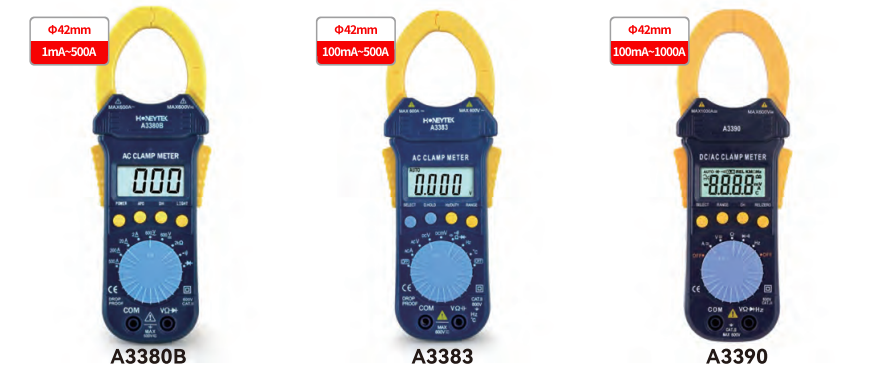
When to Prioritize a Rigid Large-Jaw Clamp Meter
Rigid-jaw clamp meters (with ferrite or iron-core jaws) remain the gold standard for accuracy, stability, and repeatability. Use them when:
🔹 Conductors are manageable in size and spacing
- Typical scenarios: single cables in distribution panels, busbars up to ~150 mm², or narrow copper bars.
- A jaw opening of 30–40 mm (or larger) can comfortably encircle most standard conductors without forcing or misalignment.
🔹 High measurement accuracy is non-negotiable
- Rigid jaws provide a fixed, closed magnetic circuit—ideal for capturing True RMS currents in motor loads, VFD outputs, or power distribution lines.
- They typically offer better linearity and lower phase error than flexible probes, especially at lower currents (<10 A).
🔹 **Currents fall within standard industrial ranges (e.g., 0–1000 A)
- Most rigid-jaw clamp meters are optimized for 600 A or 1000 A full-scale ranges—perfect for branch circuits, HVAC systems, and motor control centers.
Rule of thumb: If your conductors aren’t unusually thick, your workspace isn’t extremely confined, and you need reliable data (not just a “rough check”), go with a rigid-jaw clamp meter with adequate opening clearance.
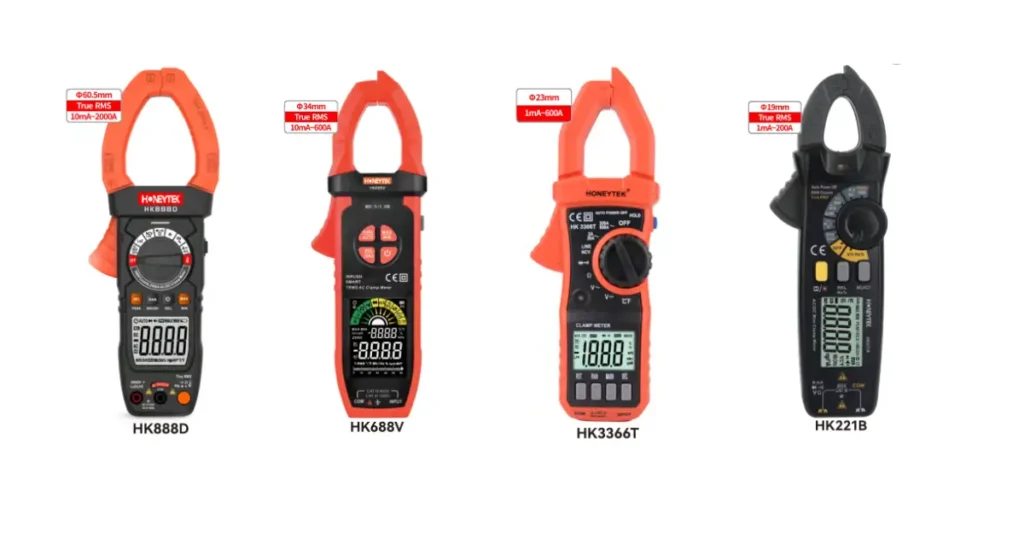
Pro tip: Choose a jaw opening 20–30% larger than your largest expected conductor diameter. For a 30 mm cable bundle, opt for a 40 mm jaw—not one that “just barely” fits.
When You Must Use a Flexible Current Probe
Flexible probes shine where rigid jaws fail—literally and figuratively. Consider them essential when:
🔹 Conductors are oversized, bundled, or oddly shaped
- Examples:
- Massive busbars (e.g., laminated or U-shaped copper bars)
- Multiple parallel cables tightly grouped
- Ring-type busbars or busways in switchgear
A flexible coil can wrap around these structures like a strap—no need to open jaws or disconnect lines.
🔹 Access is extremely limited
- In crowded panels, cable trenches, or live switchrooms, rigid jaws often can’t fully close or even reach the target conductor.
- Flexible probes can snake through gaps, bend around obstacles, and encircle conductors from awkward angles.
🔹 Currents exceed 1000 A—sometimes into the 10kA range
- Many flexible probes support 3000 A, 5000 A, or higher, especially when paired with compatible meter hosts.
- Ideal for main feeders, transformer secondaries, or large PV inverter outputs.
Think of flexible probes as your “special ops” tool: lower baseline accuracy, but unmatched accessibility and scalability.
How to Build the Right Combo: Jaw Size + Flexible Probe
A professional-grade measurement strategy isn’t “either/or”—it’s “both, when needed.” Here’s how to configure your kit:
Step 1: Size Your Rigid Jaw for Typical Work
- Audit your most common tasks: What’s the largest cable or busbar you measure weekly?
- Select a rigid clamp meter with a jaw opening comfortably larger than that (e.g., 40 mm for 30 mm conductors).
- Prioritize True RMS, CAT III 600V/1000V rating, and inrush capture.
Step 2: Add a Flexible Probe Only If Extreme Scenarios Exist
Ask: Do you ever encounter any of the following?
- Busbars wider than 50 mm?
- Cable bundles too thick for your largest clamp?
- Panels so dense that jaws can’t close fully?
→ If yes, invest in a meter that supports interchangeable probes or buy a host + flexible probe kit.
Accuracy vs. Accessibility: Know Your Priority
| Use Case | Recommended Tool | Why |
|---|---|---|
| Energy audits, load profiling, motor efficiency | Rigid-jaw clamp meter | Higher accuracy (<1.5% typical), better phase response |
| Quick overload checks, phase balance, fault hunting | Flexible probe acceptable | ±2–3% accuracy often sufficient for “is it hot?” diagnostics |
| PV string monitoring, EV charger validation | Rigid for DC/AC branches; flexible for main DC bus | Combine precision + reach |
Real-World Setup Recommendations
| User Profile | Ideal Configuration |
|---|---|
| Facility electrician / HVAC tech | One rigid clamp meter (30–40 mm jaw, 1000 A, True RMS). Flexible probe optional unless working with large MCCs. |
| Data center / industrial plant maintenance | Dual setup: Rigid clamp for branch circuits + flexible probe for main busways, UPS outputs, and generator feeds. |
| Solar EPC, electrical inspector, testing lab | Mandatory: High-accuracy rigid clamp + high-range flexible probe. You’ll face everything from rooftop strings to 4000 A switchgear. |
Critical Safety & Compatibility Notes
⚠️ Never assume compatibility: Verify that your flexible probe matches your meter host in:
- CAT safety rating (e.g., CAT III 600V)
- Frequency range (standard Rogowski coils work best at 50/60 Hz; some support up to 1 kHz)
- Maximum current and output signal (e.g., 100 mV/A vs. 1 V/A)
⚠️ Always ensure the flexible coil is fully closed and locked—any gap or twist introduces significant measurement error.
⚠️ Inspect insulation regularly: Cracks, abrasions, or exposed conductors on jaws or probes = immediate retirement. Safety isn’t optional.
In Summary: The Smart Professional’s Approach
Rigid large-jaw clamp meters = your daily driver for precision, reliability, and routine work.
Flexible current probes = your emergency toolkit for extreme size, extreme current, or extreme access challenges.
Start by choosing a rigid clamp meter with a jaw opening sized for your most common conductors—with room to spare. Then, add a flexible probe only if your job site demands it.
You May Also Be Interested In:
- AC-Only vs. AC/DC Clamp Meters: Choosing the Right Tool for Your Electrical Applications
- Why Handheld Capacitance Meters Struggle With Small-Capacitor Measurements
- Accuracy Comparison of Digital Multimeters, Portable Capacitance Meters, and LCR Meters
- Portable Capacitance Meter vs. LCR Meter: What’s the Real Difference?
- How to Measure DC Current with Clamp Meter
- True RMS Industrial Digital Multimeters: Why They Matter in Modern Electrical Systems
