
The solar industry is no longer operating at yesterday’s voltage levels. Global PV deployment continued to accelerate through 2024, with worldwide cumulative installed capacity reaching about 2,261 GW by the end of the year and 2024 annual additions estimated in the 553 GW to 601 GW range. As systems scale, higher-voltage architectures are becoming more common across utility-scale and larger commercial installations, which raises the safety and performance requirements for every test instrument used in the field.
For buyers, EPC teams, and distributors, this changes the selection logic for multimeters. A PV meter is no longer just a tool for reading voltage or current. In high-energy DC environments, it is part of the technician’s safety barrier. That is why CAT IV 1000V has become a serious procurement filter for professional solar maintenance, especially when the work involves string testing, inverter checks, combiner boxes, and other frontline troubleshooting tasks in modern PV systems. This is an inference based on how measurement categories are defined and how leading solar-focused instruments are positioned in the market.
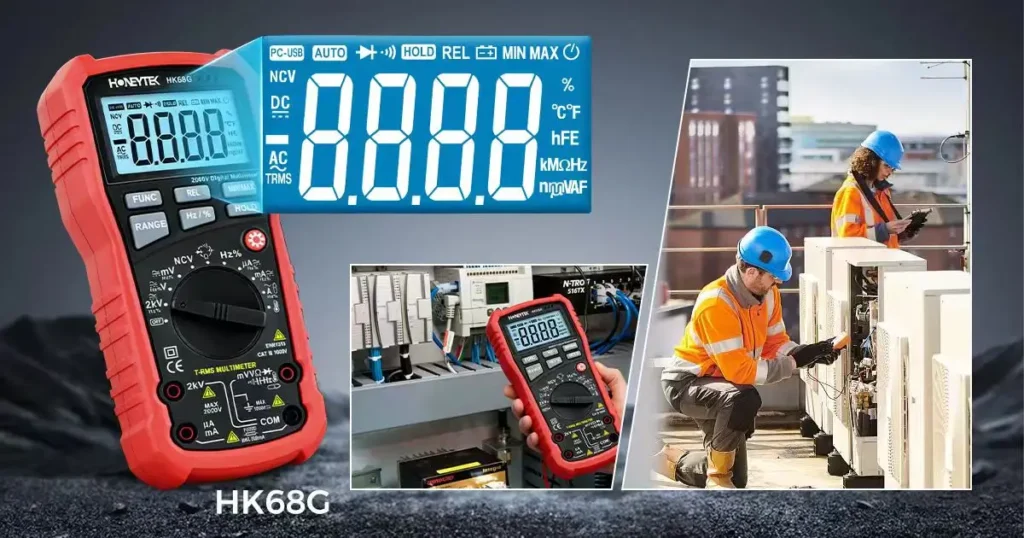
Higher Voltage Solar Systems Demand More Than a High Measurement Range
One of the most common buying mistakes is to focus only on maximum voltage range. A meter may claim 1000V, 1500V, or even 2000V capability, but that alone does not tell you whether it is appropriate for the electrical environment where the measurement is being taken. According to Megger, the CAT rating defines the level of transient surge the instrument has been designed to withstand, and a CAT label without an associated voltage rating is not meaningful.
That distinction matters in solar. Fluke’s solar-focused 283 FC/PV is explicitly rated CAT III 1500V / CAT IV 1000V, and the company positions it for technicians working in DC environments up to 1500V, including utility-scale solar arrays. Fluke also notes that CAT III 1500V DC systems are now standard in utility-scale PV applications because they support longer strings, reduce wiring and inverter requirements, and improve system economics.
What CAT IV 1000V Means in Practical PV Work
CAT IV applies to the highest-energy part of a low-voltage installation, including circuits connected between the source of the building’s supply and the first accessible isolator. Megger states that these environments can involve very high potential short-circuit current, typically greater than 50 kA, and therefore carry a higher arc-flash risk if a measurement goes wrong.
For solar buyers, that means CAT IV 1000V is not a decorative line on a datasheet. It signals that the meter was designed for tougher transient conditions and higher fault energy than lower-category instruments. In real-world PV maintenance, that difference matters far more than marketing language around “high voltage” alone. A meter that can display a number is not necessarily a meter designed to survive the environment where that number is measured.
Why Western Buyers Now Look for CAT III 1500V / CAT IV 1000V
In Western markets, buyers are increasingly careful about whether a product’s application claims actually match its safety category. That is why the combined specification CAT III 1500V / CAT IV 1000V is becoming a strong signal in solar test equipment. Fluke uses this exact positioning for its solar multimeter and matching accessories, including MC4 test leads and high-voltage silicone leads, specifically for safe troubleshooting of inverters, combiners, strings, and modules.
This also affects how products should be marketed. A meter rated CAT III 1000V / CAT IV 600V is not the same as one rated CAT III 1500V / CAT IV 1000V, even if both advertise high-voltage capability. For distributors, wholesalers, and private-label brands, correct positioning is critical because Western buyers increasingly compare safety class, application fit, and accessory ecosystem—not just the headline range on the front of the meter.
Why True RMS Still Matters in Solar Diagnostics
Safety is the first filter, but accuracy is the second. Modern PV systems are full of power electronics, and inverter-related measurements can involve distorted or non-ideal waveforms. Fluke specifically positions its 283 FC/PV as a True-RMS solution for solar professionals and emphasizes accurate, reliable, and repeatable results in high-voltage DC environments.
For maintenance teams, that matters because incorrect readings lead to incorrect decisions. If a technician is diagnosing inverter performance, checking current behavior across strings, or validating a suspected imbalance, the meter must do more than survive the environment. It must also deliver readings that can be trusted under real field conditions. That is why serious solar buyers usually treat CAT rating and True RMS as a package, not as two unrelated specifications.
How Honeytek Positions Itself for the Solar Test Equipment Market
Honeytek states that it was founded in 1998 and presents itself as a digital multimeter and measurement instrument manufacturer with 28 years of manufacturing experience. The company also says it provides OEM/ODM support for brand owners, wholesalers, and retailers worldwide, with a product range covering digital multimeters, clamp meters, and other electrical measurement tools.
For solar-focused applications, Honeytek’s HK888D is the stronger frontline option. Honeytek describes it as a solar PV clamp meter designed specifically for photovoltaic installation and maintenance, with a 2000V measurement range, 2000A AC/DC capability, dedicated PV test leads, and positioning for high-voltage solar arrays and inverters. Honeytek’s solar maintenance content also presents the HK888D with a CAT III 1500V / CAT IV 1000V safety rating, plus True RMS capability and PV-oriented use cases such as utility-scale plants, commercial rooftops, inverter commissioning, and fault diagnostics.
The HK78G, by comparison, is better positioned as a versatile high-voltage True RMS digital multimeter for inspection, troubleshooting, and general field service work. Honeytek lists it with AC/DC voltage measurement up to 2000V, multiple electrical test functions, and a CAT III 1000V / CAT IV 600V safety rating. Honeytek also highlights it for PV-related use when paired with a DC high-voltage probe, which makes it a useful complementary tool—but not a direct substitute for a CAT IV 1000V solar-first meter.
What Distributors and OEM Buyers Should Check Before Ordering
When evaluating a solar multimeter for distribution or private-label sourcing, four checks matter most.
First, verify the full safety rating, not only the range. CAT category and voltage rating must be read together.
Second, confirm that the product is positioned for actual PV work, not only general electrical testing. Solar-specific accessories and use-case alignment matter.
Third, confirm True RMS capability if the product will be used around inverters or other modern power electronics.
Fourth, assess the supplier’s OEM/ODM strength. Honeytek states that it supports OEM/ODM projects for global partners, and its official pages position the company as a manufacturer serving distributors, wholesalers, and brand owners.
Conclusion
In 2026, solar maintenance buyers are operating in a market shaped by larger systems, higher DC voltages, and tighter safety expectations. The data and product direction across the industry point in the same direction: in serious PV applications, CAT IV 1000V is no longer a premium extra—it is increasingly a baseline requirement for credible frontline measurement tools. That conclusion is supported by how measurement categories are defined and how solar-specific instruments are now specified for the market.
For importers, distributors, EPC buyers, and private-label brands, the most competitive products will be those that combine the right safety class, reliable True RMS performance, and supplier-side customization capability. Honeytek’s solar-oriented product lineup and OEM/ODM positioning place it in that conversation for buyers looking to build a stronger PV testing portfolio.
FAQ
1. Is CAT IV 1000V more important than maximum voltage range?
Both matter. Maximum range tells you what the meter can measure, while the CAT rating tells you what kind of electrical environment it is designed to withstand. Megger specifically notes that a CAT rating without a corresponding voltage rating is not useful.
2. Why is CAT III 1500V / CAT IV 1000V common in solar multimeters?
Because solar work increasingly involves high-voltage DC systems, and leading solar instruments are designed for both the voltage level and the transient-risk environment around PV installations. Fluke uses this exact rating on its solar multimeter and matching accessories.
3. Is True RMS necessary for solar maintenance?
Yes. Inverter-driven and power-electronics-heavy environments can produce waveforms that are not ideal sinusoidal signals. True RMS helps deliver more reliable readings in those real operating conditions.
4. Which Honeytek model is better for solar-focused positioning?
For stronger solar-specific positioning, the HK888D is the better fit because Honeytek presents it as a PV clamp meter for photovoltaic installation and maintenance with CAT III 1500V / CAT IV 1000V positioning in its solar content. The HK78G is a capable high-voltage multimeter, but its listed safety rating is CAT III 1000V / CAT IV 600V.
5. Does Honeytek support OEM/ODM for distributors and private-label buyers?
Yes. Honeytek’s official company pages state that it provides OEM/ODM solutions for brand owners, wholesalers, and retailers worldwide.
Looking for a digital multimeter manufacturer that understands the real demands of solar PV testing, high-voltage safety, and private-label product development?
Honeytek is a 28-year factory manufacturer specializing in digital multimeters and electrical test instruments, with solar-oriented models such as the HK888D and flexible OEM/ODM support for global partners. Contact Honeytek to discuss your target market, required safety class, and branding needs for your next PV measurement product line.
You May Also Be Interested In:
- How to Use a Clamp Meter Correctly: Why Clamping Two Wires Shows Zero Current
- Common Clamp Meter Mistakes: Misunderstanding Range and Accuracy
- How to Choose the Right Digital Multimeter
- Why Insulation Testers Are Essential for EV and Hybrid Diagnostics
- How to Measure Insulation Resistance with a Multimeter
- How to Measure Insulation Resistance in Solar PV Systems: The Professional Guide
